
Business model
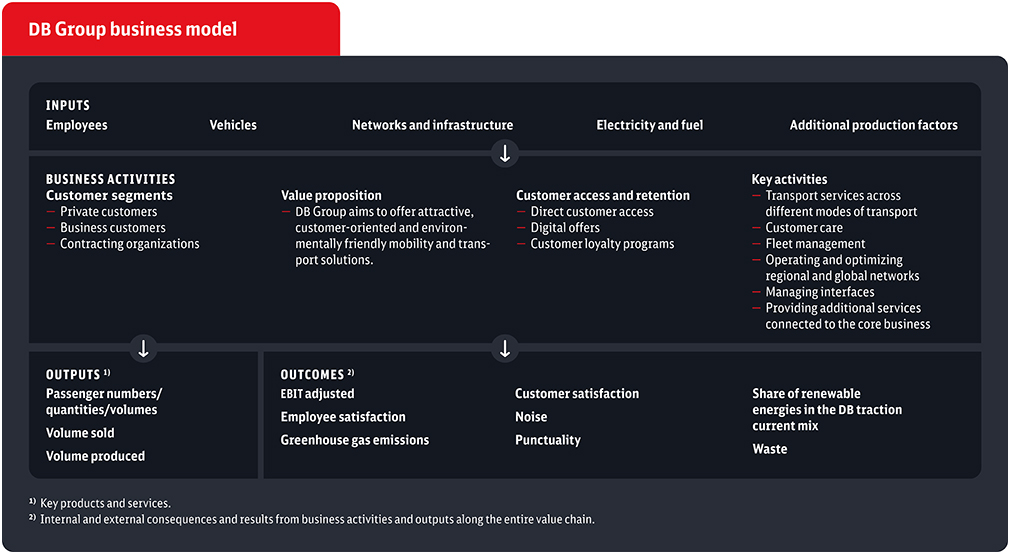
DB Group’s business model has changed as a result of the sale of DB Schenker. We are concentrating on our core business: our passenger transport activities in Germany, our rail freight transport activities and the rail infrastructure companies.
DB Group aims to offer attractive, customer-oriented and environmentally friendly mobility and freight transport solutions. To this end, we want to make targeted use of the potential of digital technologies to improve our operational and administrative processes, continually develop our services for customers, integrate new services and achieve simplifications. We want to successively develop our business portfolio in respect of mobility and freight transport to better satisfy customer needs and meet new market requirements. This also requires a robust rail infrastructure, which we also operate.
- Passenger transport: Our passenger transport activities are broadly based. The bus and rail services are supplemented by networks with other means of transport, such as cars and bicycles. We offer long-distance rail passenger transport within Germany and cross-border into neighboring countries. In bus transport, we focus on the German market.
- Freight transport: DB Cargo operates in the business-to-business segment. Our business activities in the freight transport market were placed on a European platform at an early stage. We offer our customers industry-specific solutions including intermodal transport and logistics services.
- Infrastructure: DB InfraGO is responsible for the rail network and all facilities and passenger stations required for operations. The most important source of revenues are train-path usage fees. DB InfraGO ensures non-discriminatory network access for all licensed TOCs, local transport contracting organizations and freight forwarders and shippers.
As a provider of services in passenger transport, freight transport and rail infrastructure, our economic success is also influenced by the general economic environment and developments on the relevant markets:
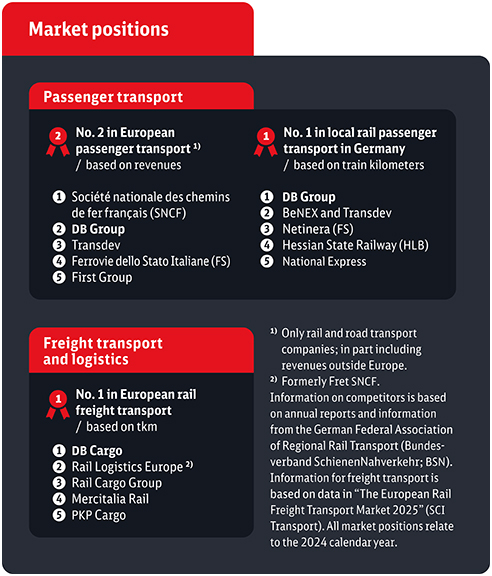
- Demand for passenger transport is driven first and fore most by the size of the population, growth of major cities, number of people in employment and real dis posable incomes. Competitiveness relative to car transport is heavily influenced by the trend in fuel prices. At DB Regional, long term transport contracts concluded with the contracting organizations of the Federal states in Germany are par ticularly important for business devel opment.
- In the area of freight transport, we are particularly de pendent on the economic development. DB Cargo’s market environment is influenced, in particular, by industrial production and trading activities. Due to our Europe-wide networks, we monitor the development of gross domestic product (GDP) in Europe and European trade. Customary early-warning indicators of the business climate and of the expectations of purchasing managers are an integral part of our monitoring system.
- Operating transport networks is normally characterized by high capital commitment, long capital expenditure cycles and high fixed costs. In this respect, achieving optimal capacity utilization of the networks and sys te matically developing, integrating and cost-effectively operating these networks with the efficient use of re sources are important to DB Group’s economic develop ment.
Development of the economic and early-warning indicators, as presented above, influences how we manage our market activities and resources. This is aimed at identifying opportunities and risks at an early stage, so that short-term management activities and long-term positioning can be aligned accordingly.
The development of DB Group is driven by success factors that are central components of our business model.
- Corporate social responsibility: As a state-owned provider of mobility and freight transport solutions, DB Group bears great responsibility for the future of our country. As the basis of climate-friendly and networked mobility and the freight transport of tomorrow, rail should fulfill a key function for Germany: it should help to achieve climate protection targets, promote participation and quality of life for people and strengthen the business location as well as people and the economy. In brief: society should also benefit from a strong rail system. Our business activities are geared towards the long-term realization of Strong Rail.
- Lean Group structure: We are developing DB Group into an efficient, clearly managed organization. This is based on clearly assigned responsibilities, simplified structures and efficient work and decision-making processes. A lean organizational structure, the systematic reduction of overhead and significantly greater decentralization are intended to create the structural conditions for greater impact, speed and responsibility at the local level.
- Unbundling within the integrated Group: DB Group stands for the integrated Group, so that infrastructure and transport operations on the infrastructure are optimally interlinked in order to deliver the best possible result for customers. By clearly separating DB InfraGO AG, which is oriented towards the common good, from purely competitive activities, DB Group ensures unbundling within the meaning of the Federal Government.
- Digitalization: We want to use the technologies and methods of digitalization to offer attractive products. We strive to support our internal processes with technologies, such as artificial intelligence (AI), so that we can continue to offer customers an appropriate price level with efficient processes.
- Europe as the field of action: As the geographical and economic heart of Europe, Germany has a special responsibility for the future of the continent. Europe is our field of action in freight transport and international long-distance passenger transport to the major cities of neighboring countries.