
DB Group
Organizational structure
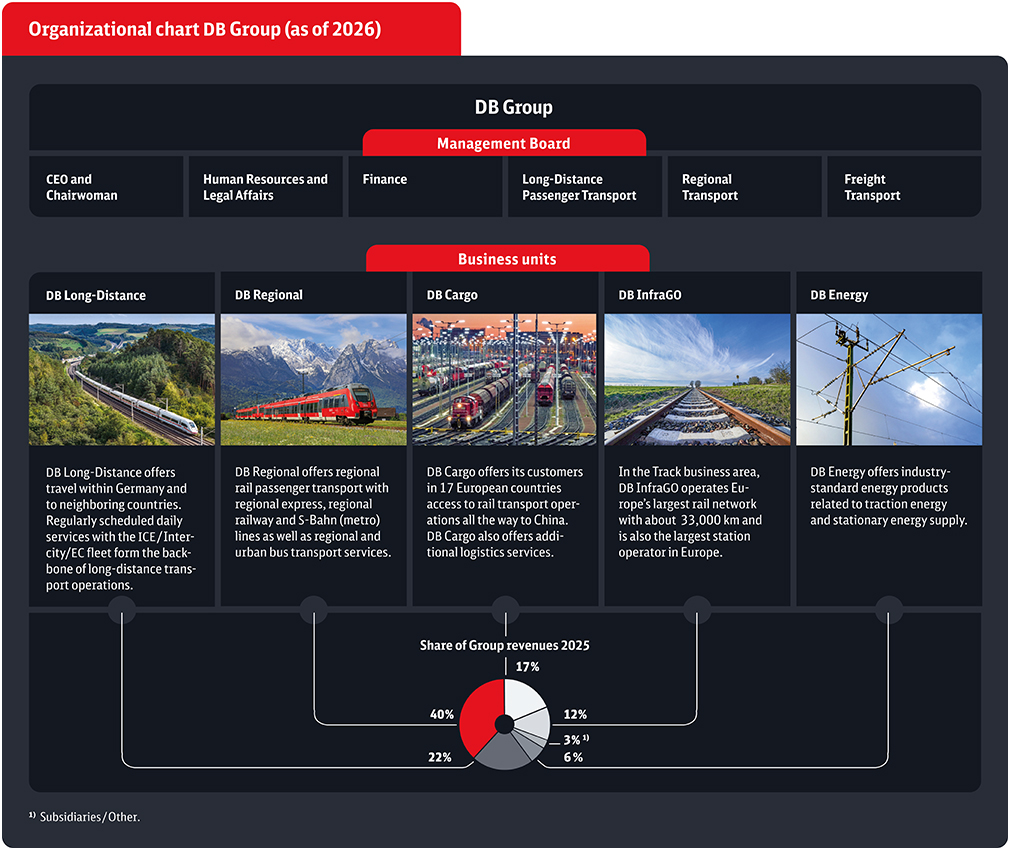
DB AG is the parent company of DB Group. It has been a stock corporation under German law since it was founded in 1994 and accordingly has a dual management and control structure comprising a Management Board and a Supervisory Board. The sole owner is the Federal Republic of Germany.
Since January 1, 2026, there has been a new Group structure as part of the the “restart” of DB Group. The change begins in the Management Board: instead of eight, there are now only six Board divisions – the Infrastructure and Digitalization and the Technology Board divisions have been dissolved and their tasks distributed to other divisions.
Changes in the composition of the Supervisory Board and Management Board are presented in the report of the Supervisory Board.
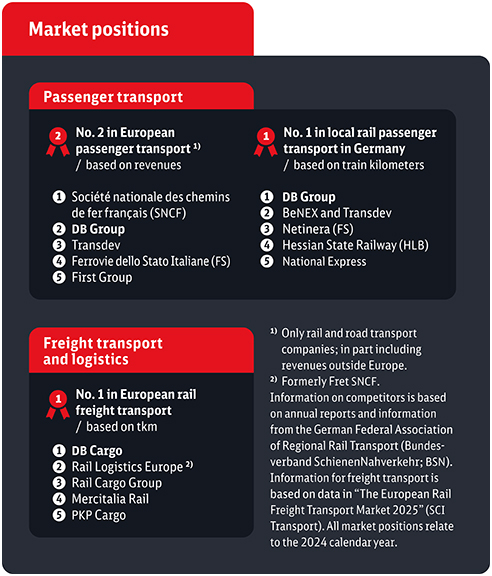
Market positions
DB Group, with its headquarters in Berlin, employs about 219,000 people. DB AG manages all business units as an operating management holding company and supports the business units through various central Group functions (including human resources, finance, legal, Group development) and administrative service units. In addition, operational service units as legally independent subsidiaries of DB AG primarily provide services for intra-Group customers. These include DB Systel GmbH, DB Sicherheit GmbH and DB Services GmbH.
Geschäftsmodell
Business model
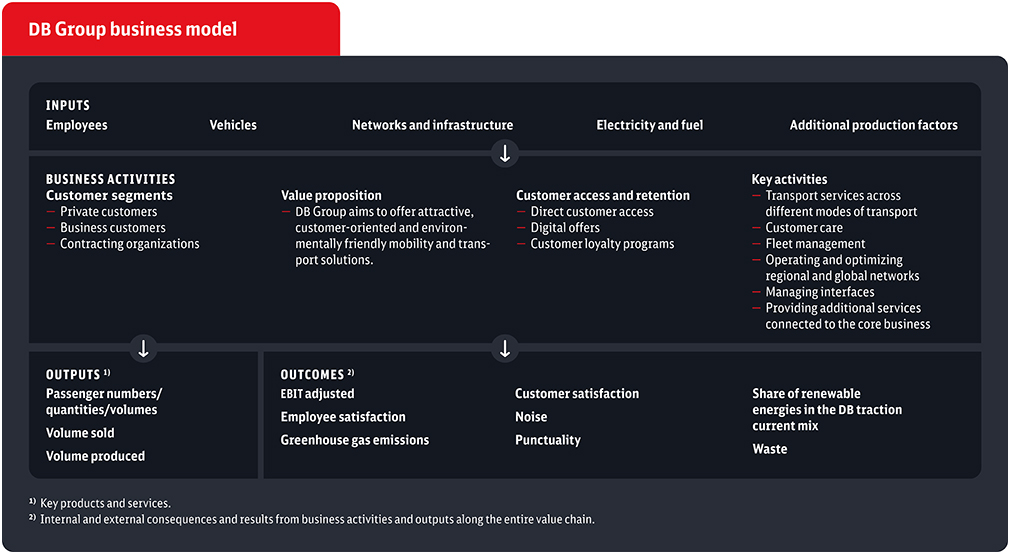
DB Group’s business model has changed as a result of the sale of DB Schenker. We are concentrating on our core business: our passenger transport activities in Germany, our rail freight transport activities and the rail infrastructure companies.
DB Group aims to offer attractive, customer-oriented and environmentally friendly mobility and freight transport solutions. To this end, we want to make targeted use of the potential of digital technologies to improve our operational and administrative processes, continually develop our services for customers, integrate new services and achieve simplifications. We want to successively develop our business portfolio in respect of mobility and freight transport to better satisfy customer needs and meet new market requirements. This also requires a robust rail infrastructure, which we also operate.
Sustainability management
Transporting more people and more freight by rail represents an important lever for achieving the German and European climate protection targets. After all, rail is one of the most climate-friendly modes of transport. In order to secure the future viability of DB Group and strengthen its own business model, DB Group intends to further expand this competitive advantage. DB Group also wants to support its customers in achieving their own climate protection targets.
The high-level importance of sustainability in DB Group, with its aspects that fall within the environmental, social and governance dimensions, is reflected, for example, in the anchoring of climate protection, but also of social issues such as employee satisfaction or the share of women in leadership in the Strong Rail strategy. Sustainability is also anchored in the variable remuneration of the Management Board members, executives and other employee groups.