
2040 climate protection target
DB Group’s net-zero target:
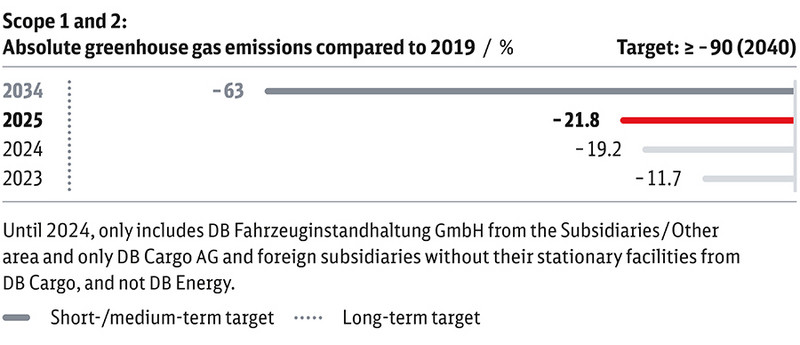
- By 2040: We have committed to reducing our greenhouse gas emissions to net zero across the entire value chain, that is a reduction in Scope 1 to 3 emissions of at least 90 % compared to 2019. From 2040, we want to neutralize the residual emissions of no more than 10 % that are difficult or impossible to avoid (i.e. permanently remove them from the atmosphere), in particular from the upstream and downstream value chain.
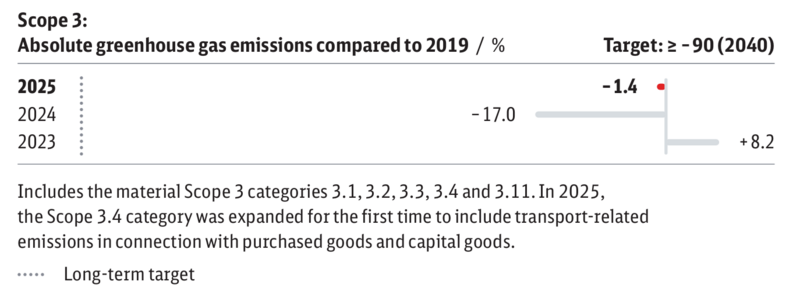
This target was confirmed by the SBTi in March 2025. Our climate protection target thus follows a 1.5 °C path according to the SBTi, making it consistent with the Paris Agreement and Germany’s climate protection target.
In addition to DB Group’s net-zero target, we have set ourselves interim targets that have also been confirmed by the SBTi.
We intend to reduce our absolute greenhouse gas emissions in our own operations and in the upstream and downstream value chain as follows:
- By 2034:
- 63 % of Scope 1 and 2 emissions,
- 40 % of Scope 3.3 emissions (from energy- and fuel-related activities), and
- 63 % of DB Group’s Scope 3.11 emissions (from the use of fossil fuels sold to third parties) compared to 2019.
- By 2029:
- 66 % of suppliers (according to emissions volume) of DB Group’s purchased goods, services and capital goods (Scope 3.1/3.2) should have science-based emissions reduction targets – this represents our supplier engagement target (SET).
As part of the regular review of our climate protection target as provided for in the resolution on the 2040 climate protection target, which took place in 2025, we have updated our greenhouse gas reduction pathways and harmonized them with the targets submitted to the SBTi. This resulted in an adjustment to the interim target for 2034 for the reduction of Scope 1 and 2 emissions compared to the previous year (previous year: 66 %). An interim target for DB Schenker’s Scope 3.4 emissions was defined in 2024. Following the sale of DB Schenker, the remaining share of DB Group’s Scope 3.4 emissions is very low compared to the other material Scope 3 categories, so no new interim target has been defined.
Further information on the level of target achievement of the interim targets can be found under Scope 1, 2 and 3 greenhouse gas emissions (E1-6).
The monitoring of our target achievement is focused on DB Group’s absolute greenhouse gas emissions. The implementation of the resolutions and targets is controlled and reviewed as part of Group-wide planning and monitoring.
In the context of DB Group’s net-zero target, the contribution of the associated decarbonization levers can initially be approximated based on the size of the underlying greenhouse gas emission sources as follows:
The largest Scope 1 and 2 greenhouse gas emission sources in the base year 2019 were:
- Electricity consumption:
- Traction current: 2.1 million t CO₂e
- Stationary electricity for stations, depots and buildings: 0.8 million t CO₂e
- Fuel consumption (mainly for rail and road transport): 1.1 million t CO₂e
- Heating and cooling: 0.2 million t CO₂e
In Scope 3, the largest greenhouse gas emission sources correspond to our identified material Scope 3 categories in the base year 2019:
- Scope 3.1/3.2: Purchased goods, services and capital goods: 4.3 million t CO₂e. About 70 % of this is attributable to the construction of rail transport and station infrastructure and about 20 % to the procurement of rolling stock and spare parts.
- Scope 3.3: Energy- and fuel-related activities: 2.3 million t CO₂e
- Scope 3.4: Upstream transport and distribution: 0.5 million t CO₂e
- Scope 3.11: Use of sold products: 0.9 million t CO₂e
We are currently working on a forward-looking analysis of the contributions of the respective decarbonization levers.
The consequences of climate change were taken into account when determining and quantifying the levers as part of the SBTi validation.
Methodology of target formulation
The methods, assumptions and scenarios are based on SBTi’s Corporate Net-Zero Standard, which also forms the basis for the target formulation.
Our net-zero targets refer to total emissions as gross targets, meaning that all greenhouse gas emissions from our greenhouse gas emissions inventory are included. The reported medium-term and long-term targets in Scope 3 relate exclusively to their respective category. DB Group’s medium-term and long-term planning as well as potential changes in future business performance, regulatory factors and new technological developments were taken into account when setting the targets. The base year 2019 was chosen as it was the last representative year before the Covid-19 pandemic.
As part of the regular review of the 2040 climate protection target as provided for in the Management Board resolution on the 2040 climate protection target and carried out in 2025, the absolute Scope 1 and 2 greenhouse gas emissions were completed by systematically expanding our database and integrating previously unrepresented smaller subsidiaries from the Subsidiaries/Other area. The base year 2019 was also adjusted accordingly. The climate protection target will also be regularly reviewed and revised in the future.