
Business model
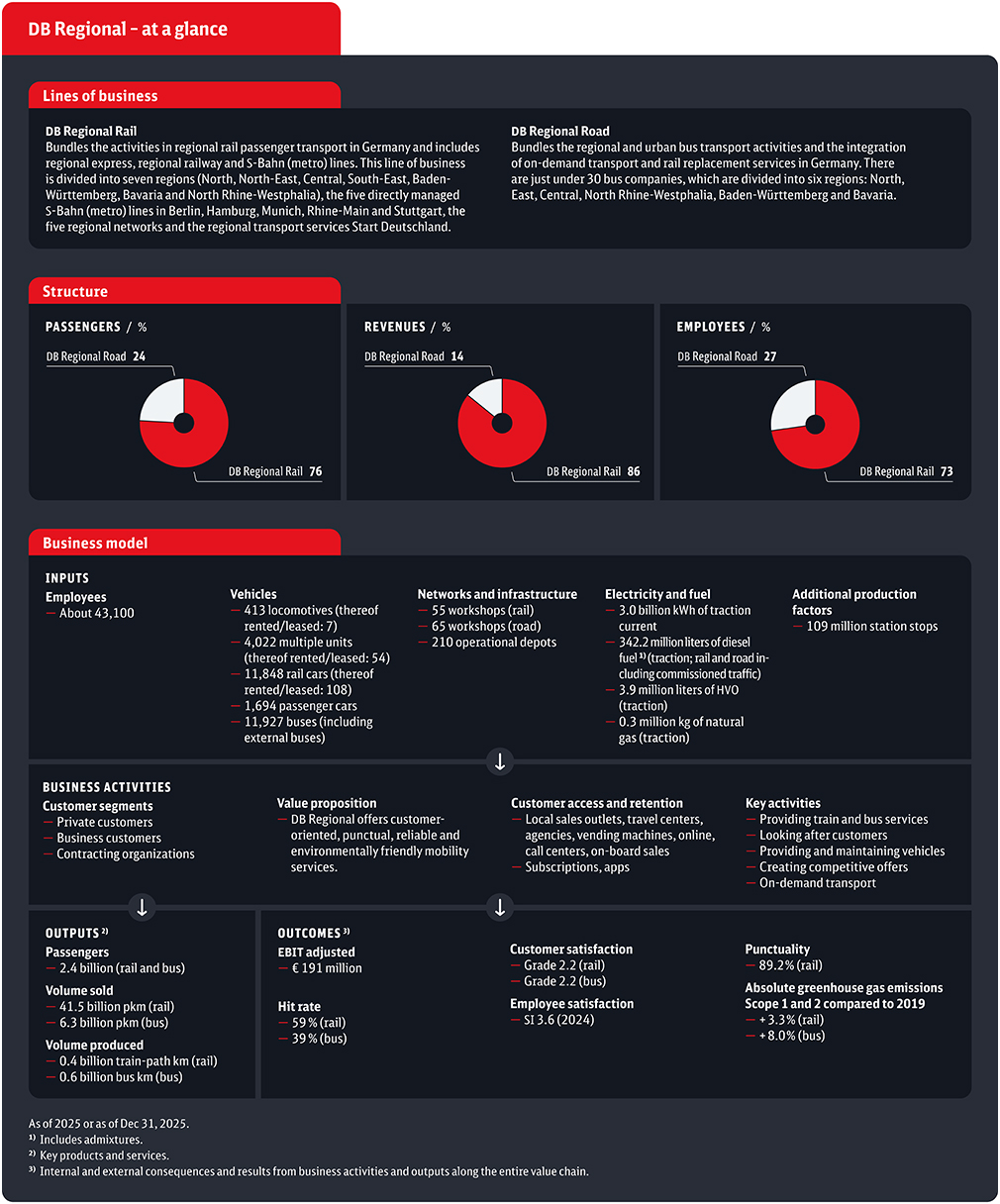
DB Regional pursues the goal of bringing millions of passengers in regional transport to their desired destinations every day in a safe, punctual, comfortable and environmentally friendly manner – always in compliance with the requirements of the respective transport contracts.
The core business comprises regional rail passenger transport with regional express, regional railway and S-Bahn (metro) lines as well as public road passenger transport, which includes scheduled services as well as flexible or demand-oriented services that do not operate according to a fixed schedule. These include regional, city, intercity and express bus lines and, particularly in areas and times of low demand, digital on-call buses or on-demand shuttles that can be booked by phone or using an app. These services are supplemented by charter and rail substitute transports. This ensures comprehensive and versatile mobility.
To address new user groups and ensure a high level of customer acceptance, DB Regional is focusing on the continuous integration of existing mobility elements at a physical, digital and tariff level. This holistic approach is aimed in particular at suburban and rural areas to establish public mobility as a public service and as an alternative to private cars in these areas. On-demand transport has a particular role to play as a feeder to traditional local public transport, supported by intelligently scheduled and interconnected services and digital technologies.
Together with contracting organizations and implementation partners, DB Regional is pursuing the successive expansion and further development of such forward-looking transport concepts. The regional organizational structure of DB Regional enables local transport services to be tailored to the needs of the contracting organizations and local customer requirements.
As a rule, regional rail passenger transport services are provided within the framework of the Regionalization Act as a public service on behalf of the respective contracting organizations – predominantly Federal states, state-owned companies or municipal special-purpose associations. Long-term transport contracts (usually with a term of 10 to 15 years) or route concessions that specify the scope and quality of services are concluded in the course of mostly competitively awarded tenders.
Through high-quality transport concepts, customer-oriented mobility services and targeted capital expenditures in vehicle fleets, product development and digitalization, DB Regional intends to safeguard its leading market position and strengthen its role as a quality and innovation leader in regional rail passenger transport.
Important performance indicators are volume sold and volume produced, with transport contracts usually relating to volume produced. In addition to the concession fees, revenues from ticket sales are also an important source of income. Gross contracts, in which the fare proceeds remain directly with the contracting organization and the transport company is compensated exclusively by the contracting organization, are becoming increasingly important.
Long-term transport contracts and the provision of extensive production systems lead to a cost-intensive structure with a high share of fixed costs, especially in the case of personnel, vehicle, maintenance and infrastructure costs. Only a small portion of expenses varies with train capacity utilization.
Traditionally, rail tenders have often required integrated service packages (vehicle procurement, financing, fleet management, operation and maintenance). There is growing use of fragmented award models in which individual services – such as financing, operation or maintenance – are tendered or awarded separately. Thanks to its comprehensive expertise in all stages of the value chain, DB Regional can act flexibly as a system service provider, partial service provider or subcontractor.
Competition in public road passenger transport remains intense due to Europe-wide tenders and a small-scale, local market with about 400 contracting organizations, such as districts, independent cities or special-purpose associations. Gross contracts with a term of eight to ten years are common here.
In the case of urban transport, transport services are often transferred directly from the responsible contracting organization to a municipal transport company via in-house tenders, a special form of direct awarding. These municipal companies can appoint regional transport companies (e.g. local bus companies) as subcontractors to operate individual lines or parts of the service.
The integration of scheduled and on-demand services opens up further potential for efficiency in public road passenger transport, but increasingly requires functionally designed tenders. In addition to execution, the contractor is responsible for planning and designing the service – always with a focus on customer orientation.