
Sustainability management
Transporting more people and more freight by rail represents an important lever for achieving the German and European climate protection targets. After all, rail is one of the most climate-friendly modes of transport. In order to secure the future viability of DB Group and strengthen its own business model, DB Group intends to further expand this competitive advantage. DB Group also wants to support its customers in achieving their own climate protection targets.
The high-level importance of sustainability in DB Group, with its aspects that fall within the environmental, social and governance dimensions, is reflected, for example, in the anchoring of climate protection, but also of social issues such as employee satisfaction or the share of women in leadership in the Strong Rail strategy. Sustainability is also anchored in the variable remuneration of the Management Board members, executives and other employee groups.
- The Chief Sustainability Officer (CSO) is responsible for sustainability issues. The office is held by the Chief Executive Officer (CEO) of DB AG. The CSO’s perspective is thus incorporated in a very central role in all important Group decisions. With regard to climate-related decisions, the CEO is also significantly involved in strategy development in his dual role. In 2025, the Management Board defined the climate protection and climate resilience areas of action as sustainability focus areas. The CEO is also responsible for occupational safety issues. Responsibility for employee issues and compliance lies with the Management Board member for Human Resources and Legal Affairs.
- The overall coordination of Group-wide sustainability issues is the responsibility of the Head of Sustainability and Environment, who is assigned to the Group Strategy division. The Head of Group Strategy is the highest function with responsibility for sustainability-related issues below the Management Board, and reports directly to the CEO. Specific tasks include, among other things, the definition of the sustainability strategy, associated Group-wide targets and metrics, their planning and monitoring, and the planning, management and implementation of Group-wide transformation projects.
- All relevant stakeholders from Group management and the business units are represented on our Sustainability Board. Together, the participants are responsible for achieving the sustainability targets. In particular, the Sustainability Board is responsible for tracking the achievement of the sustainability work program adopted by the Management Board, which is further developed on an annual basis. In the first quarter of 2025, in line with the mandate of the Sustainability Board, the sustainability work program was further developed in collaboration with the business units and service units, which specifically directed the focus of the sustainability strategy towards climate protection and climate resilience.
- The strategically oriented Sustainability Board is supported at a technical and content-related level by the Group Sustainability and Environment Committee and its specialist groups. Together, the two bodies drive forward projects and measures relating to sustainability across the Group.
- Operational responsibility for specialist sustainability issues lies with the respective specialist departments or business units.
- Group management focuses its compliance work on centralized governance activities, in particular. Operational responsibility is exercised in the business units and service units by implementing the minimum Compliance Management System (CMS) requirements of Group management. Adjustments to the structural and procedural design of the CMS are planned for 2026.
- Employee issues are supported by the Human Resources (HR) Group functions within Group management. Group-wide implementation is performed in coordination with the business units. Aspects of occupational health and safety are centralized. The business units integrate and take these into account in their business activities within the respective management systems.
In addition, DB Group is in dialog with relevant external stakeholders and assesses and manages regulatory issues. The aim is to derive recommendations and guidelines for action for DB Group from the findings. The business units and service units are responsible for implementing the targets, strategy and measures.
Across the board, DB Group uses various environment monitoring tools to continuously analyze developments in the area of sustainability, in particular current environmental legislation procedures. Our sustainability radar is the basis for the core process of defining our strategy, as it focuses on opportunities and risks and is intended to enable us to regularly review our strategy and derive any adjustments that need to be made to it. The sustainability radar incorporates relevant signals from regulatory bodies (i.e. laws and plans), stakeholders, academia and internal developments within DB Group. Standards and norms, as well as relevant Environmental, Social, Governance (ESG) ratings and benchmarks are also included in the sustainability radar. The review concludes with a look at trends. The use of environment monitoring tools, participation in ESG ratings and rankings, and involvement in national and international (sustainability) networks are intended to help ensure that trends and drivers, as well as opportunities and risks, are monitored and strategically and technically assessed by the Sustainability and Environment Group function. This is also intended to ensure Group-wide access to specialist knowledge on sustainability and environmental issues.
Sustainability issues have a high priority as part of the Strong Rail strategy. In 2025, the Supervisory Board was informed on a quarterly basis through the so-called Supervisory Board Management Report and the Management Board on a monthly basis – among other things in steering meetings attended by the members of the Management Board and the business units managements – about the current status of sustainability performance (e. g. with regard to greenhouse gas reduction, noise reduction, resource conservation and women in leadership). The CEO / CSO is regularly informed about sustainability-related topics (2025 including bi-weekly jours fixes with the Head of the Group function Sustainability and Environment).
With regard to compliance risks, the Chief Compliance Officer (CCO) regularly informs the Management Board about the expansion of the compliance program and significant compliance cases. The Management Board also received the Annual Compliance Report in 2025. The report describes the risk exposure of business units, service units and central Group management functions in detail, and highlights existing risk-reducing factors and countermeasures. The CCO also reports on compliance issues, including Group-relevant and critical issues, once a quarter in the Audit and Compliance Committee formed by the Supervisory Board.
Sustainability in remuneration
The structure of the variable remuneration of Management Board members, executives and other employee groups in DB Group is essentially geared towards sustainability targets with a focus on a sustainable mobility and transport transition and, as a result, a noticeable reduction in CO₂e emissions in DB Group and in the transport sector in Germany, all in line with the transport policy targets of the German Government:

- The long-term variable remuneration (long-term incentive; LTI) of Management Board members and senior executives with an LTI commitment includes a target to reduce absolute greenhouse gas emissions and volume targets for a sustainable shift in the mode of transport to rail as key factors. Achieving these targets is the key lever for reducing greenhouse gas emissions both within DB Group and in the transport sector in Germany as a whole.
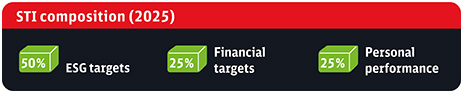
- In addition, the short-term variable remuneration (short-term incentive; STI) of the Management Board members, executives and other employee groups (non-collective bargaining and collective bargaining employees) also includes key performance indicators for a sustainable shift in the mode of transport based on the long-term Strong Rail targets: customer satisfaction and punctuality, employee satisfaction and the share of renewable energies in the DB traction current mix. In addition, personal performance is taken into account as a further component for the variable remuneration of executives and employees not subject to collective bargaining agreements.
The variable remuneration component for the members of the Supervisory Board resulting from the achievement of sustainability-related targets is 20 %, provided that both the sustainability-related target and the financial target have reached the same level of achievement.
Details on the remuneration of the Management Board and Supervisory Board are set out in the remuneration report.
ESG ratings
Feedback from ESG rating agencies is an important benchmark for us and an indicator of our stakeholders’ concerns. More information is available on our investor relations website.
| ESG ratings | 2025 | 2024 | 2023 | Last update | Rating scale |
|---|---|---|---|---|---|
| CDP (climate rating) | A | A | A– | Jan 2026 1) | A to F |
| EcoVadis | 80/Gold | 71/Silver | 68/Silver | Jun 2024 | From 2024: Platinum: the best 1 % Gold: the best 5 % Silver: the best 15% Bronze: the best 35% |
| ISS ESG | B– | B– | B– | Nov 2025 | A+/4.00 to D–/1.00 |
| MSCI | A | A | A | Dec 2024 | Leader (AA – AAA) Average (BB – A) Laggard (CCC – B) |
In alphabetical order.
1) CDP published the results of the 2025 climate rating in January 2026.
Changes in 2025:
- CDP: In the CDP rating, DB Group once again achieved the best possible rating of “A” in 2025, putting it above the industry average of “B” in rail transport. DB Group performed very well in areas such as corporate strategy, governance, data on greenhouse gas emissions in Scope 3 and transparency.
- EcoVadis: With its overall score of 80, DB Group is among the top 5 % of companies assessed by EcoVadis in 2025 and the top 1 % of companies assessed by EcoVadis in the rail transport sector, and with this score has once again significantly improved its rating compared to the previous year. The sector average is 55 points. DB Group was also awarded a gold medal for its sustainability performance. We achieved significant improvements in the areas of environment, ethics and sustainable procurement, in particular.