
Business model
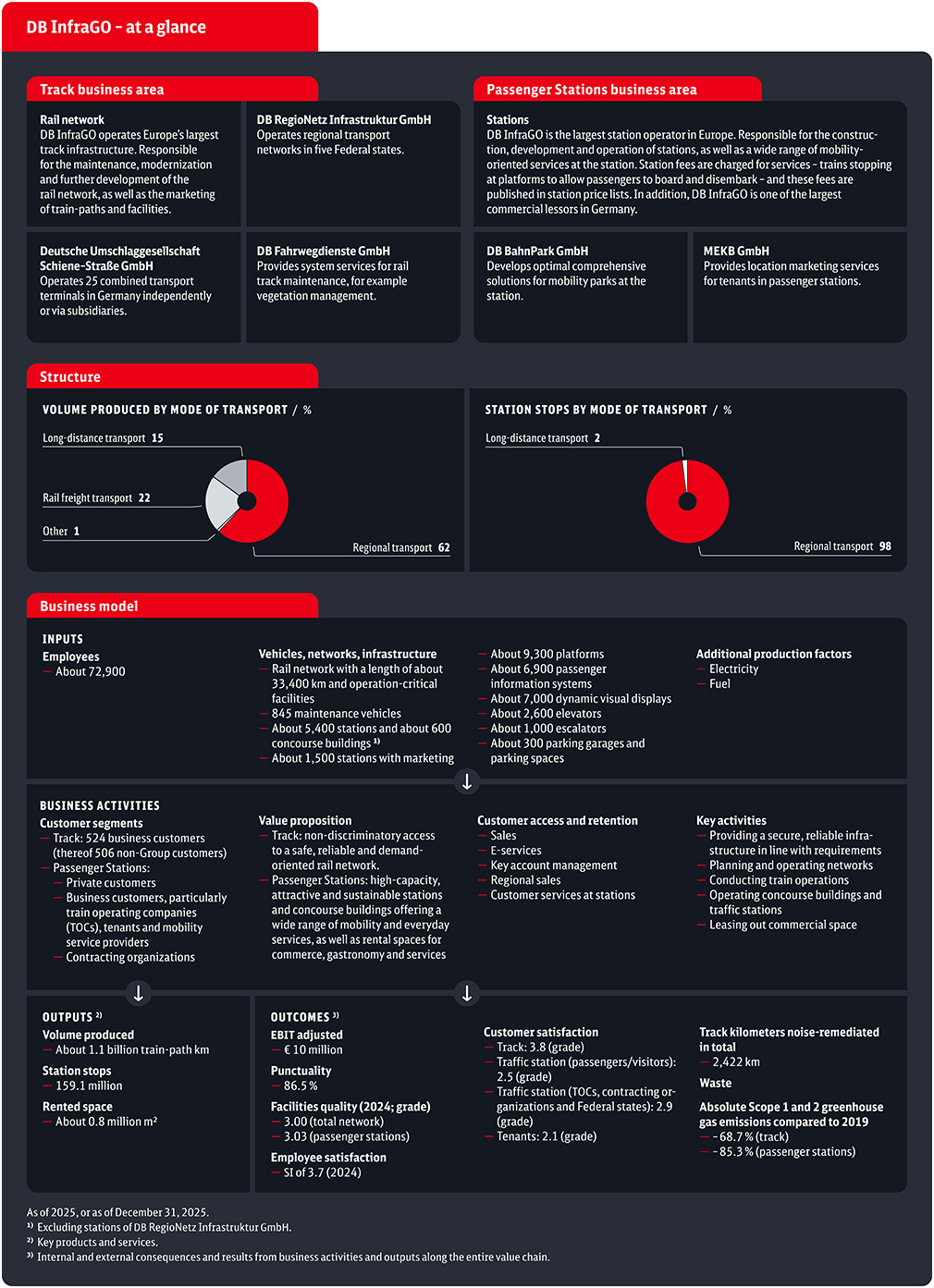
DB InfraGO shapes and operates Europe’s largest rail network, spanning over 33,000 km, as well as about 5,700 passenger and traffic stations.
DB InfraGO’s guiding principle sets forth the company’s purpose. The core mission is to design and operate a safe, powerful and robust rail network – with attractive and high-performing stations.
This purpose was developed in collaboration with representatives from the sector and politics. The guiding principle expresses society’s expectations of DB InfraGO. The focus is on the five dimensions performance capability, customer orientation, common good orientation, sustainability and team spirit. The guiding principle also defines a shared understanding of the customer across all business areas of DB InfraGO, thereby laying the foundation for a unified approach throughout the entire business unit. The focus is on the users of the rail system – passengers, companies and station visitors. A successful train run, however, can only be achieved through cooperation with business partners: about 400 train operating companies (TOCs), 27 contracting organizations, as well as about 1,800 siding owner and about 2,100 commercial tenants in the stations. The goal is to strengthen this partnership through joint product development and active participation in shaping the future of the rail system.
DB InfraGO’s most important product is the provision of train-paths in line with requirements, reliable, and future-oriented. More than one billion train-path kilometers are traveled on the rail network each year. Revenues from train-path usage, which account for about 79% of total revenues, are DB InfraGO’s most important source of income. Train-path prices are set in a transparent and non-discriminatory manner within the framework of the train-path pricing system (TPS) regulated by the Federal Network Agency (Bundesnetzagentur; BNetzA). The cost structure has a high share of fixed costs. The track network in particular is one of the biggest cost drivers. Resource use for the operation and maintenance of infrastructure facilities is very much influenced by specific facility characteristics, requirements relating to operational opening hours and the degree of rationalization in operating business activities. Since the dimensions of the infrastructure can only change in the long term through expansion and new construction projects or targeted dismantling, optimal capacity utilization of the infrastructure is crucial to its performance capability. Given the generally stable demand from the contracting organizations and TOCs, coupled with the simultaneous increase in construction volume, optimizing capacity utilization will remain a key aspect.
As Europe’s largest station operator, DB InfraGO is responsible for the development, construction and operation of passenger and traffic stations, and offers a wide range of services in this segment. With about 830,000 m² of rental space, DB InfraGO is also one of Germany’s largest commercial lessors. At passenger and traffic stations, the focus is on improving the quality of stay and the services offered to customers in order to ensure a high level of quality. On-site station management teams ensure smooth operations. The design of the products and services, as well as the structural dimensions of the stations, are based on the needs of customers and the requirements of an economically stable infrastructure. Revenues in the Passenger Stations business area are generated primarily from station stops (regulated) for the use of stations and from the leasing of commercial space (unregulated). Station fees are subject to a regulated pricing system that – similar to the train-path pricing system – is approved annually by the BNetzA. The expense side is characterized by a high fixed-cost component.
Key regulatory partners for DB InfraGO are the BNetzA and the Federal Railway Authority (Eisenbahn-Bundesamt; EBA).
DB InfraGO provides various service facilities to support the preparation and post-processing of train runs. These include, among other things, parking facilities, auxiliary equipment, loading points, scheduling tracks and marshaling yards. These service facilities are available with a variety of features, equipment levels and capabilities. They ensure that the TOCs’ logistical requirements can be met as needed. The use of service facilities is governed by the Network Terms of Use (Nutzungsbedingungen Netz; NBN) and is based on a regulated facility pricing system.
Sidings serve as the interfaces between DB InfraGO’s rail infrastructure and the networks of other railways. They enable a continuous rail transport chain between shippers and various receiving locations. Sidings are an essential component of integrated logistics concepts and help link rail, water and road modes of transport – especially when transporting large volumes of goods. The Federal Government supports capital expenditures in sidings through a siding funding program. The authorizing authority is the EBA.