
Organizational structure
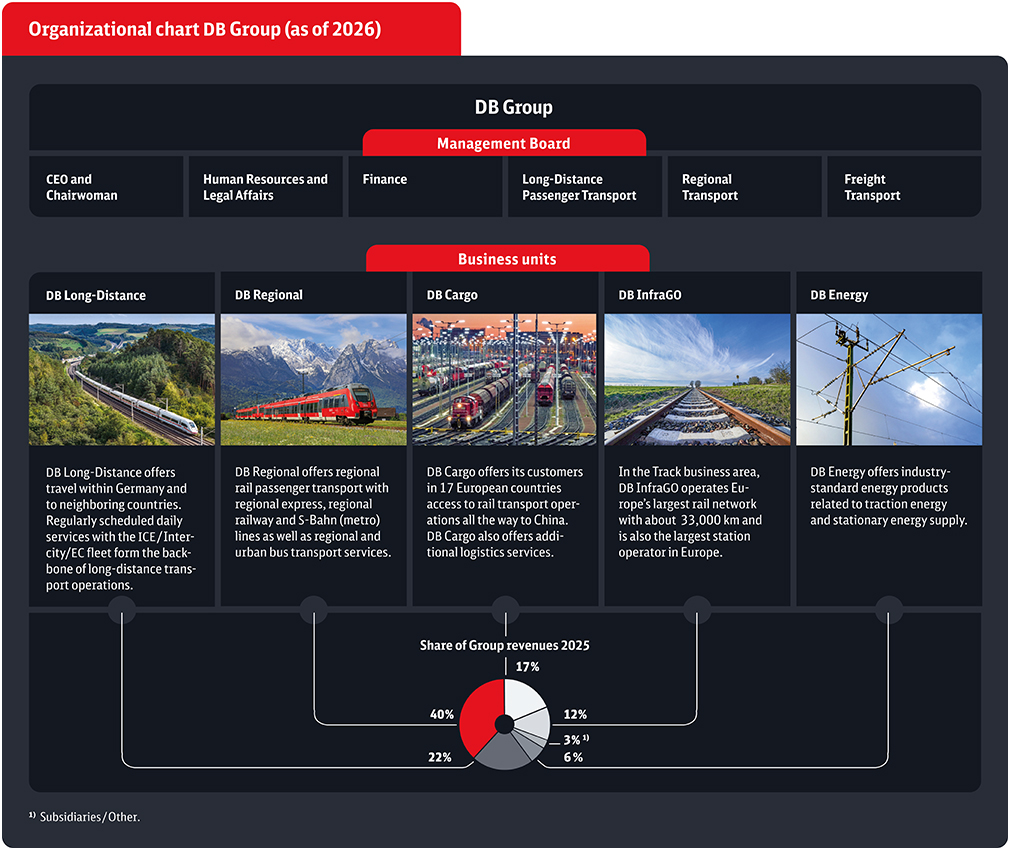
DB AG is the parent company of DB Group. It has been a stock corporation under German law since it was founded in 1994 and accordingly has a dual management and control structure comprising a Management Board and a Supervisory Board. The sole owner is the Federal Republic of Germany.
Since January 1, 2026, there has been a new Group structure as part of the the “restart” of DB Group. The change begins in the Management Board: instead of eight, there are now only six Board divisions – the Infrastructure and Digitalization and the Technology Board divisions have been dissolved and their tasks distributed to other divisions.
Changes in the composition of the Supervisory Board and Management Board are presented in the report of the Supervisory Board.
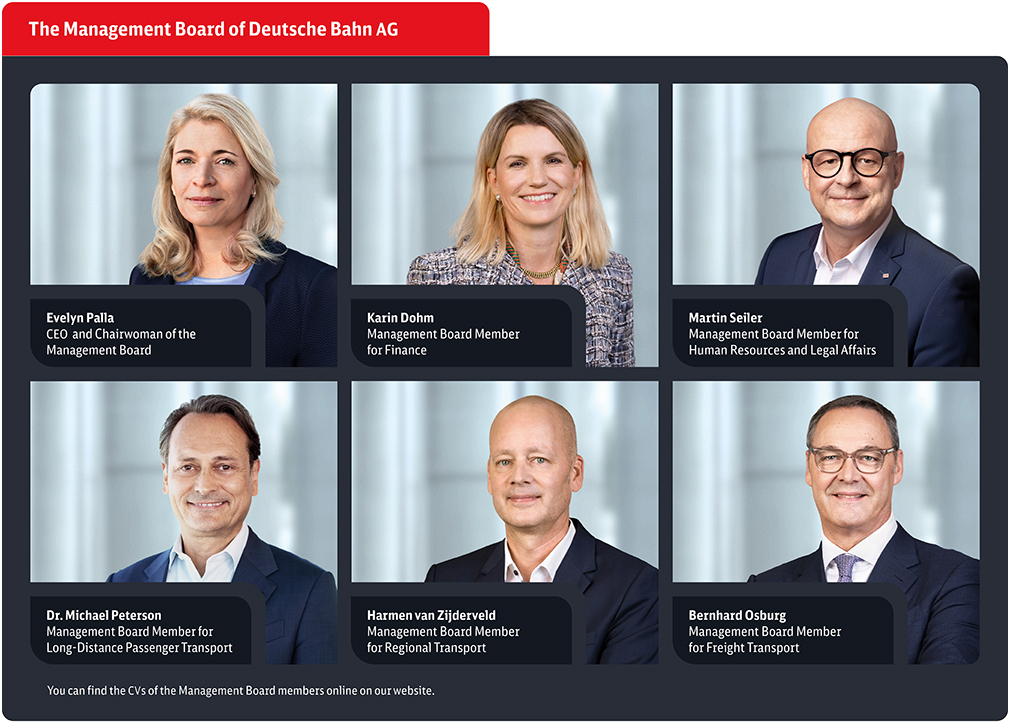
DB Group comprises passenger transport activities, rail freight transport activities, operating service units and rail infrastructure companies (RICs).
DB Group is the leading provider of passenger transport in Germany and rail freight transport in Europe. We also operate the longest rail network and the largest traction current grid in Europe.
With the sale of DB Schenker, DB Group’s last major international subsidiary, in April 2025, the focus on the core business in Germany was driven forward in 2025. Further steps are to follow.
DB Group, with its headquarters in Berlin, employs about 219,000 people. DB AG manages all business units as an operating management holding company and supports the business units through various central Group functions (including human resources, finance, legal, Group development) and administrative service units. In addition, operational service units as legally independent subsidiaries of DB AG primarily provide services for intra-Group customers. These include DB Systel GmbH, DB Sicherheit GmbH and DB Services GmbH.
With the Strong Rail strategy DB Group is pursuing the goal of a shift in the mode of transport to rail in the long term. To this end, we rely on integrated operation of transport and rail infrastructure, the economically and environmentally intelligent linkage of all modes of transport, as well as cooperation in German and European networks. As a prerequisite for the further shift in the mode of transport to rail, the highest priority is to increase operating quality and improve profitability.
The train operating companies (TOCs) of DB Group are legally and economically independent companies with separate balance sheets and statements of income, and thus fulfill all unbundling requirements under European and national law. In addition, DB InfraGO is legally and organizationally unbundled, which guarantees independent decisions on train-path applications, train-path construction, train-path allocation and train-path usage fees. Reliability and stability form the basis of a high-quality infrastructure. A key cornerstone is the sustainable financing of infrastructure. The Performance and Financing Agreement (Leistungs- und Finanzierungsvereinbarung; LuFV) makes a significant contribution to ensuring the maintenance and modernization of the existing network. The LuFV is to be further developed into the InfraGO Performance Agreement (Leistungsvereinbarung InfraGO; LV InfraGO).