
Business model
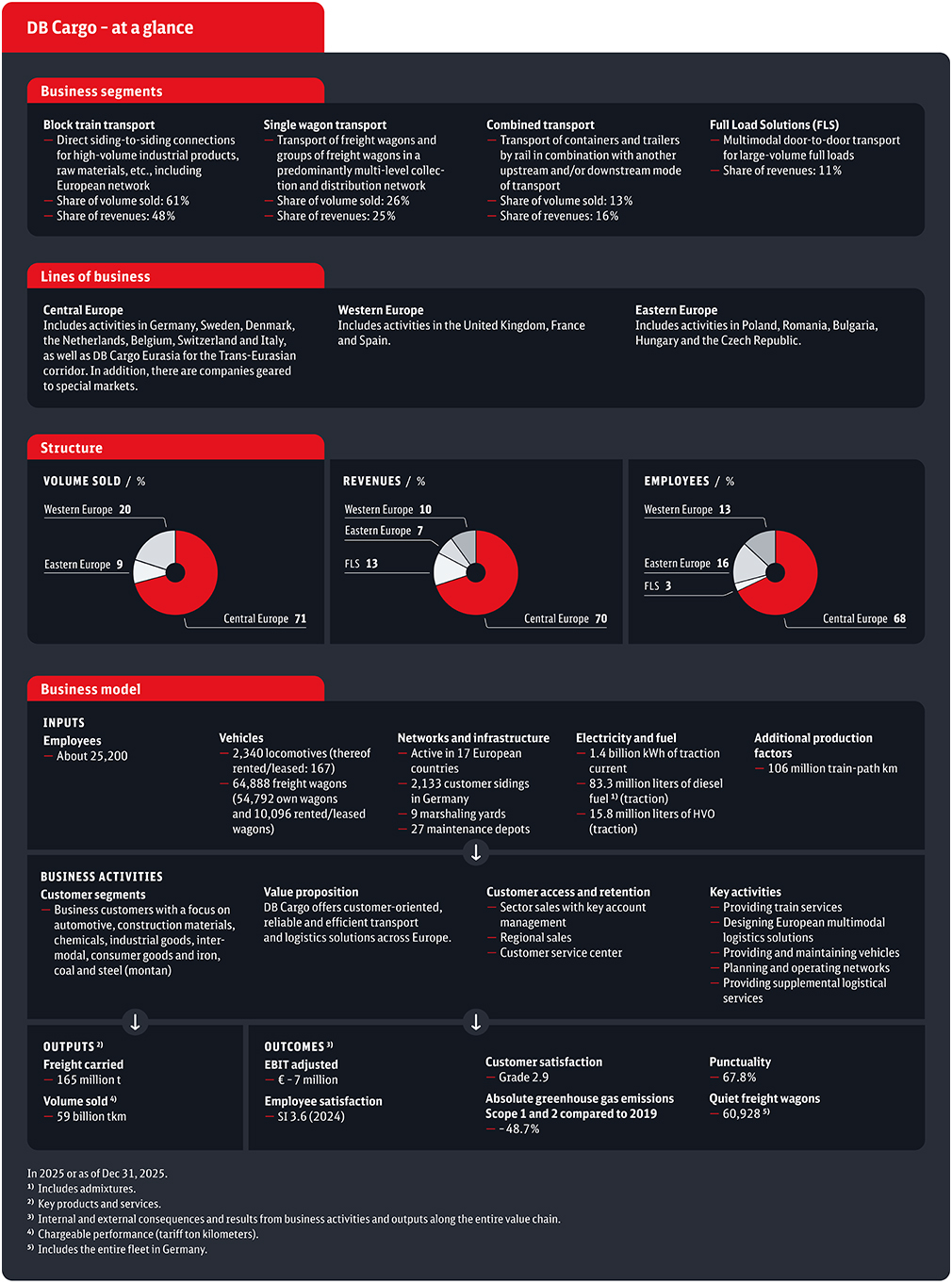
As a European provider of rail freight forwarding services along international freight corridors, DB Cargo offers its customers access to a Europe-wide rail and logistics network. DB Cargo transports individual freight wagons and wagon groups using the single wagon transport system, enables transport chains for containers or truck trailers using several modes of transport (rail, ship, truck) in combined transport, and operates direct block train transports from siding to siding for its customers throughout Europe.
In addition to pure transport services, DB Cargo provides its customers with complete logistics concepts, from transport and storage through the distribution of customer products. Several modes of transport are combined to provide this service. DB Cargo uses its own or rented locomotives and freight wagons, terminals, marshaling yards, distribution centers, its own employees and the transport, personnel and other services of third-party cooperation partners. In these transport concepts, customers’ products are transported by truck from the production sites to a nearby transshipment terminal. The long section of the transport is completed by rail to a transshipment terminal near the distribution center. From there, the goods are delivered to the end customer by truck. To implement these end-to-end concepts, DB Cargo relies on cooperation with non-Group partners with the aim of providing complete solutions. In this way, DB Cargo combines rail and industry expertise with the services of its European partner network. These transport concepts also reduce the associated greenhouse gas emissions for customers, as there is a shift from fossil-fuel-powered truck transport to rail transport using electrical energy generated primarily from renewable sources. Non-Group customers include the manufacturing industry in the automotive, steel, recycling, chemicals, commodities, mineral oil, building materials, industrial and consumer goods sectors, as well as shipping companies, freight forwarding companies and combined transport operators throughout Europe. DB Cargo also sells traction and other services to intra-Group customers (among others DB InfraGO).
Since DB Cargo generates the majority of its income by transporting goods by rail, the leading performance indicator is volume sold in ton kilometers.
In addition to the depreciation for locomotives and freight wagons and personnel costs, the main cost components are expenses for energy and infrastructure as well as other operating expenses for maintenance and services provided by non-Group logistics partners. DB Group’s infrastructure and service companies are important suppliers in this respect.